Thursday, 16 January 2020

2 popular horse breeds: Clydesdale and Belgian Draft Horse

Do you know 2 popular horse breeds: Clydesdale and Belgian Draft Horse? This article will show you many interesting facts and compare them!

How Similar Are The Belgian Draft Horse vs Clydesdale?

They are both pretty meaty, a common characteristic of draft horses, and strong enough to pull large weights.
Like the Clydesdale, the Belgian horse has many white markings through the main coat (on the legs, face, mane, and tail).
It is also true that both the Belgian draft horse and the Clydesdale are easy to train, willing to work and eager to learn.
Now, let’s check out how different these horses are.

The Differences

Belgian Draft HorseClydesdale
Imagebelgian draft horseClydesdale Horse Lifespan
OriginationThe Brabant region of BelgiumClydesdale, Scotland
Life span30 years20 to 25 years
Average Weight2000 pounds1600 to 2400 pounds
Average Height168 to 173 centimeters162 to 183 centimeters
Colors* Most are chestnut
* Can be sorrel and roan
* Bay or brown are popular
* Can be black, sorrel, or roan, grey, and chestnut
TemperamentKind, gentle, calm, docile, steady and easy-to-handleAlert, active, gentle, responsive

UsesHistory:
* Known for carrying knights in war
* Post-war period: they were used in farms and also for meat while in the USA they were used for agricultural purposes and pleasure riding.
Today:
* Used for draft works (plowing, logging, pulling sleighs, hitches, and carriages).
* Used for pleasure riding, show jumping, dressage, and endurance.
History:
* Agricultural purposes (heavy draft, pulling freight wagons or plowing steep, rough hills);
* Crossed with thoroughbreds and quarter horses to produce strong, heavier-boned riding horses.
Today: popular in shows and parades and used as fancy carriage horses
Body type
BodyMuscular and powerful with a square head, heavily muscled gaskinsMore streamlined with strong and muscular shoulders
FaceStraight or slightly concaveWide (usually has a white stripe on the face), straight with a slight convex nature, intelligent-looking eyes
TailsLongerdocked
NeckShort, muscularlong and well-arched; shows more crest
HindquartersShort, broad backBulky
HoovesMedium-sizedLarger and round (around five pounds each)
FeatherHas some featheringHas heavy feathering in lower legs
Generally speaking, while the Belgian draft horse seems to be shorter, stockier, and also, a little longer-lived, the Clydesdale is available in more colors.
It is impossible to say which breed is better and deserves to be the winner in this comparison. Ultimately, it depends on whether you care more about their uses or appearance, their strength or temperament.

Conclusion

Those are similarities and differences you can consider to identify a more appropriate horse breed.
We hope that the above comparison between the Belgian draft horse and the Clydesdale will be useful for you.

Wednesday, 15 January 2020

Horses vs Dogs - Who are smarter?

Horses are very smart, but if Horses compare with Dogs, who are winners? Just find yourself the answer after reading this post !

Are Horses Smarter than Dogs?

Horse Intelligence 

As previously stated, horses are intelligent enough; even, in comparison with some of the pieces, they are smarter.
Apart from the self-learning capacity, horses can also work things out for themselves, escaping themselves from the dangers in the field included.
Being a fast learner, a horse is easy to get the accuracy and consistency when training.
Even, both the daily routine and the feeding time are clearly recognized.
In spite of being easily upset, you can solve this issue with the reward training.
For the associations, horses make them with a range of things, which cause many problems.
As an example, horses will respond in a couple of times when mounted. But, they gradually get used to it.
Frequently, you can trace the problems through the unpleasant experiences; and then, rely on these to rectify.
By what means?
It is not difficult to overcome horses’ association. You can feed them or supplement others as long as they like.
Like that, you might turn the unpleasant ones.
Remember that you do not use punishment or force in these cases. You not only cannot improve the situation but also make everything worse.
Most interestingly, you may even teach your horses to recognize the short words, along with meaning.
It would be best to give the appropriate words and come with the proper tone. Your horses will likely understand.

How Horses Are Smart If Compared to Dogs

Debating on the animal intelligence is never simple.
According to what Einstein said, everybody is a genius. There will be stupid if you rely on one piece’s feature to compare to another.
How Horses Are Smart If Compared to Dogs
To answer this question, I recommend that you continue reading my article below:
While both horse and dogs are loyal animals, how their intelligence will be:
Don’t have to depend on the brain mass to measure.
The larger the animals the larger the brain mass will be, but that is to control the sensory processing and muscle.
Obviously, humans have the largest ratio of the brain to the body. It means that we are super smart. No! No!
It is necessary to look at how we think and what we are good.
As a general rule, animals hunting another prey are more intelligent than herbivores. No herbivore must need to use lots of brain power in order to eat grass.
Of course, horses are not a hunting animal. But, it is noticed that they have the emotional intelligence and social sensitivity based on herd structures.
You do not impossibly believe what I am saying right now:
Dogs only have 16 recognizable facial expressions while horses are 17.
Consequently, from weather changes or someone who is stressed or angry, horses can sense through their whiskers and smell pheromones.
And let prove the horse intelligence, I introduce to you, Clever Hans. This horse might answer numbers via his hoof.
“If Thursday is exactly the eighth day of this month, what is the date on the next Friday?”
Hans accurately answered in an absolute way.
Yes, you can understand that the horse has read the emotion. And Hans would not recognize the problem once you blindfolded him.
What about dogs? Are dogs smarter than humans?
According to a recent study, dog intelligence is approximately a two-year-old human.
This one can relate to their personality.
Averagely, dogs can understand 150 human words. When being asked simple calculations, dogs can even answer in a quick and exact manner.
For instance, with the calculation: 1+1=3, dogs can completely put an accurate answer.

Which Is Smarter a Horse or a Cow?

Which Is Smarter a Horse or a Cow?
From the beginning, I have repeated horse intelligence one more. So,
How intelligent are horse compared to other animals?
In particular, if compared to a cow, how there will be.
Look at farms, personally, I do not highly appreciate cow intelligent rank. Cows never appear on the top smart animals.
Despite being dumb, horse intelligence ranking is still higher than cows.
Learn words, sound, movements, voices, or patterns. With horses, these things are not too difficult.
Whether being taught or learning themselves, the list of things horses can do is endless.
If you train both cow and horse, you will recognize:
The cow cannot find any way to get away from work. They will try to work during the time.
On the contrary, horses figure out the strategies to get rid of working or even utilize cheat. This comes naturally.
In some cases, cows still work whether you are not there.
Another outstanding feature of horses is the ability to plan and detect dangers. They are almost calm in most dangerous situations. That’s why most farms raise horses.

In a Nutshell, Are horses smarter than dogs?

We can understand horses as an intuitive animal.
For dogs, the ability to remember and learn is surprising.
I am obviously unbiased. Probably, the brain mass allows them to remember both equines and canines. Even, there are plenty of going on that I or you do not likely know.
I hope that this article is helpful for you to understand horses more.

Monday, 13 January 2020

Are Horses Ruminants Or Non-ruminants?

Are horses ruminants? Do horses have the four-compartment stomach like cattle, cows, sheep, goats?
The answer is NO. Horses are a non-ruminant which has a simple stomach that works much like a human’s.

Ruminants vs. Non-ruminants

Before digging deeper into non-ruminants, let’s learn a little bit about ruminants.
Ruminants are mammals which can acquire nutrients from plant-based food by fermenting it in a specialized stomach before digestion.
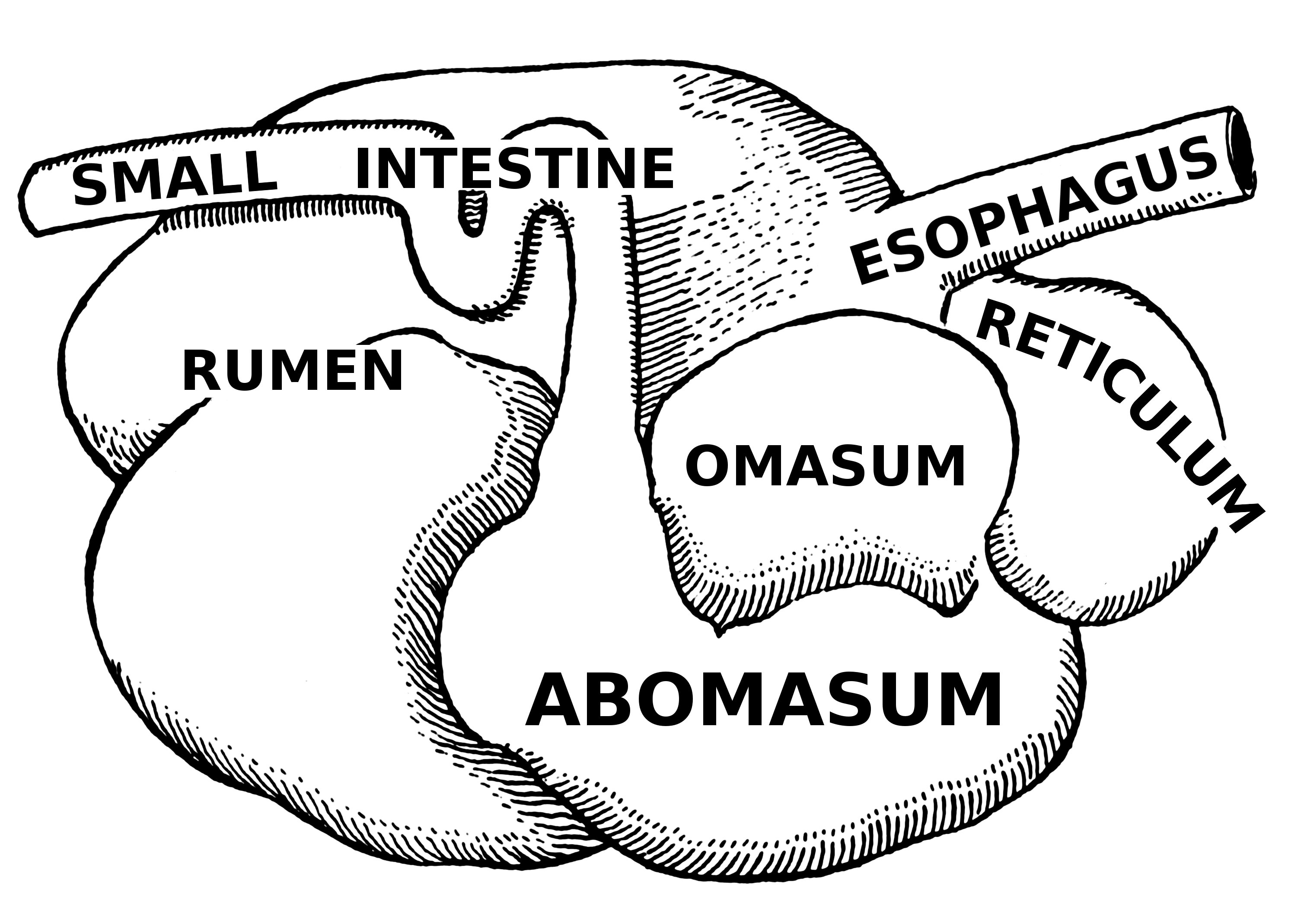
Cattle, sheep, goats, buffalo, deer, elk, giraffes and camels are animals which belong to ruminants. These animals all have a digestive system that is uniquely different from our own. Instead of one compartment to the stomach, they have four.
ruminant digestive system
An illustration of a ruminant digestive system – Source: Wikipedia
Digestion of ruminants includes two processes: foregut fermentation and rumination.
The former takes place in the front part of the digestive system, that typically requires the fermented ingesta (known as cud) to be regurgitated and chewed again. The latter includes the action of rechewing the cud to break down plant matter and stimulate digestion.
On the other hand, non-ruminants are also called “monogastric”- animals with a single-compartment stomach. Examples of monogastric animals are humans, primates, swine, dogs, cats, and even horses.
For instance, the horse is a non-ruminant herbivore. Non-ruminant means that horses do not have multi-compartmented stomachs as cattle do. Instead, the horse has a simple stomach that works much like a human’s. Herbivore means that horses live on a diet of plant material.
The equine digestive tract is unique in that it digests portions of its feeds enzymatically first in the foregut and ferments in the hindgut.
horse digestive system
A horse’s digestive system – Source: Equinenutritionnerd.com

How To Take Care Of Horses?

Here are some primary criteria which you should follow to look after your equine friend(s).

Nutritional Needs

A horse’s digestive system is made to process large quantities of grass, which is high in fiber and water. The basic diet for most horses should be grass and good quality hay, free of dust and mold.
Plenty of fresh, clean, unfrozen water should be available at all times, even if the horse only drinks once or twice a day.

Vaccinations and Deworming

All horses need injections, and most need regular deworming. You should discuss the specifics for your horses with an equine veterinarian.
You should protect horses from tetanus. Vaccines for West Nile Virus are also available. You should ask your veterinarian if other vaccines are appropriate for your horse.
Worms can cause weight loss, poor coat, and colic, which can be deadly. It is best to have your veterinarian test and deworm your horse, or advise you on what to use and when.
More important than treating worms is minimizing the horse’s exposure to parasites. Proper management entails not putting too many horses on too little land, rotating pastures if possible, and removing feces regularly.

Housing, Rest and Exercise

Horses isolated in box stalls can develop behavioral problems from lack of companionship, exercise, and mental stimulation. Whenever possible, horses should be outside with other horses every day.

Extreme Weather Precautions

Unless it is very wet and windy, horses tolerate cold much better than heat and humidity. If they can’t sweat, they can’t get rid of heat buildup in their bodies.
If the sum of the temperature in degrees Fahrenheit and the relative humidity in percentage is over 130, you should be cautious about exercising your horse. If it is over 150, you should probably rest in the shade, and if it is over 180, most horses should not work at all.

Hoof Care

Hooves should be trimmed every six to eight weeks for horses whose feet do not get adequate natural wear.
Some hoof problems are directly related to shoeing. However, changes should not be made suddenly or without expert guidance. You should consider finding a veterinarian or farrier willing to discuss all the options may be hard, but worthwhile.
best horse hoof boots reviews
A pair of hoof boot will protect horse hooves better!

Teeth

Horses’ teeth grow continuously. Uneven wear can lead to sharp points and edges that cause pain and difficulty chewing. A horse’s teeth should be checked once or twice a year and “floated” (to make them smoother) by a veterinarian or well-trained equine dentist as needed.
Dental problems, from painful to rotting teeth, may cause difficulty chewing or “quidding,” which occurs when food falls out of the mouth. Other signs of the dental disease may include foul breath, undigested hay in the stools or discomfort from the bit or noseband.

The Problem is Solved: “Horse are non- ruminants”

Horses just have a single stomach instead of the four-compartment one like ruminants.
Also, you should consider six aspects: (1) Nutrition; (2) Vaccinations and deworming; (3) Housing, rest and exercise; (4) Extreme weather; (5) Hoof care; (6) Teeth; to take care of your horses better.

Thursday, 9 January 2020

Facts about Arabian Horse Price

Price of an Arabian Horse is the number which many horse lovers want to know. And in this post, I will answer that question with many others interesting information about this beautiful breed!

What is exactly Arabian Horse price?

The planet’s most expensive one has been Marwan Al Shaqab – a stallion. He is so valuable that the owner rejected a $20 million bid to buy him.
The price is dramatically variable depending on many factors. According to the Arabian Horse Association, the current listed prices range from $500 to $155,000. More commonly, it spans from $5,000 to $85,000. Still, the average cost for most of the Arabian horses will be $5,000 – $20,000.

Factors Affecting Their Purchase Price

These are some main factors that have to do with the cost of Arabian horses:

1. Appearance (Conformation)

The Arabian horses stand about 15 hands high. Their coat has the colors of gray, bay, black, and chestnut. Their skin is black. The mane is high-set and full, as is the tail. The face and legs may have white markings. (source: Wikipedia)
You may have to pay higher prices for the horses that satisfy these breed criteria.

2. Lineage

There is a variety of Arabian horse strains. Among them, the purebred Desert variety is the rarest. They are the original Bedouin Desert Arabian. Higher prices may be paid for them.
Desert Arabian horse
Source: http://daughterofthewind.org
There are other distinct lineages and they can be complicated. Arabians from various pedigrees are categorized and cataloged by The World Arabian Horse Organization (WAHO). WAHO may be of great assistance if you have questions related to the price of an individual horse.

3. Full or half

Both half-Arabian and full-Arabian horses are well-favored these days. By the half-Arabian, we mean a combination of a full Arabian horse and another purebred one.
Current listings show that half-Arabians’ price ranges from $500 to $75,000. Meanwhile, the prices for full Arabians are currently between $500 and $155,000.
Half-Arabian Horse

4. Option to part-own or lease

You can find chances to lease Arabians as part of a lease-to-own agreement or temporarily. Thanks to this option, your up-front costs of buying an Arabian may be reduced significantly.
A lot of Arabians also have more than one owner. If you buy into a limited liability company (LLC) or partnership, the up-front costs over a longer-term investment in an Arabian can be spread out.

Monday, 9 September 2019

FAQs about Ulcer Supplements for Equines

Why Should You Use The Horse Ulcer Supplement?

Best Horse Ulcer Supplements Reviews


Why Not Medicine?

Researchers from Veterinary Clinics of North America propose some reasons including:
  • The expensive FDA-approved drugs require long-term use, and pharmaceutical agents ask for a veterinarian prescription.
  • Gastric ulcers usually recur after stop using the drug, so they need constant treatment.
  • Long-term use of omeprazole can reduce stomach fluid acidity and cause negative digestion affects.
  • Some medicines are restricted in performance horses, and you have to use alternative and complementary therapies.
  • People use Omeprazole to treat and prevent Equine Gastric Ulcer Syndrome (EGUS), but a large number of drugs are in the mixture such as antacids and stomach protectants.

Why Should Supplement?

Also, in the article of the above researchers, therapies for EGUS need to identify and overcome the causes, environment control, diet, and pharmaceutical intervention. Owners should look for products with ingredients to help maximize digestive health as follows:
  • Pectin forms a gel when exposed to acidic environments and binds bile acids, protecting the lining of the gastrointestinal tract.
  • Lecithin reduces surface tension.
  • Saccharomyces cerevisiae (live yeast), Sea Buckthorn (rich in vitamins and antioxidants).
  • Dietary oils for the balance between omega-6 and omega-3.
  • Minerals (like zinc) promote skin healing and support immune function.
Ulcers in Stomach of Horses
Horses can have ulcers in stomach or colon – Source: succeedfbt.com

Frequently Asked Questions

How Many Types Of Ulcers Are There In Horses?

Ulcers usually develop in the stomach although they can form in the colon. They are called Equine Gastric Ulcer Syndrome (EGUS) with two primary diagnoses:
  • Equine Glandular Gastric Ulcer Syndrome (EGGUS) – a rare form: Because the glandular lining can withstand harsh acids and is less prone to pain or injury, it occurs more in racehorses than endurance horses.
  • Equine Squamous Gastric Ulcer Syndrome (ESGUS) – more popular: 60-80% of horses with gastric ulcer symptoms are diagnosed with ESGUS.
Warning: Ulcers in horse stomach can lead to the development of hindgut or colon ulcers, which are more challenging to diagnose and need careful treatment.

What Causes Ulcers In Horses’ Stomach?

You should talk to a veterinarian to determine the ulcer causes. Understand the causes helps you to plan treatment and maintain effective long-term care. Here they are:
  • EGGUS is caused by the deterioration of the mucosal lining, covering the glandular of horse stomach, formed by horse stomach acid. Or other reasons are the regular use of non-steroidal anti-inflammatory drugs (NSAIDs) and bacterial infection.
  • ESGUS is also derived from stomach acid, bacteria or parasites because squamous has mucosal lining and lacks defense mechanisms for glandular protection.
  • Colon ulcer: Because colonic ulcers tend to form from gastric ulcer, they are affected by the same causes of EGGUS and ESGUS.

What Do You Feed A Horse With Stomach Ulcers?

You use diet and nutritional management in combination with medical therapy to reduce the severity and recurrence of ulcers:

Raise in graze

Horse grazing pastures are less likely to develop ulcers than those in cages. You should avoid feeding your horse only two large meals a day, not enough water, social isolation with other horses, and lack of exercise.

Maximize forage

Alfalfa feeding with high levels of calcium, magnesium, and protein protects the stomach lining. You provide every 100 kg of body weight with 1-1.5kg of good quality forage or hay all day and night.

Minimize grain

You limit the intake of grains to a maximum of 0.5kg per 100 kg body weight per day. You need to feed hay first, then grains to prevent ulcers and do not feed grains less than six hours apart. Remember to replace any sweet feeds, barley or oats with lucerne hay or good quality grass.

Provide plenty of water

You need to make sure your horse has access to clean drinking water. The reason is that horses eat less when you restrict the provided water, then reducing eating leads to a decrease in alkaline saliva production to buffer stomach acid, increasing the risk of ulcers.
For horses in training, avoid repeated oral administration of mucus or hypertonic electrolyte replacement solutions that increase the severity of stomach ulcers.  Instead, you give your horses small meals.
>>> Read more about the Best Automatic Horse Waterer
Best Automatic Horse Waterers Reviews

How Long Do Ulcers Take To Heal In Horses?

Depending on the type of treatment and severity, ulcers can take from one week to more than a month to heal. Remember to complete the full treatment plan, even if the symptoms disappear. Symptoms are relieved because the medicine is active; it doesn’t mean that the ulcers heal completely.
The veterinarians should conduct follow-up tests such as endoscopy or fecal blood tests before ending the treatment. You should also consult them when using supplements or probiotics for your horse. They can advise you on the dosage, medication usage, side effects, and the change of eating and stalling habits.